
Disciplined AI Engineering Your Team Owns
Stride embeds senior AI engineers in your team to turn AI speed into shipped, accountable software, then leaves the discipline behind so your team runs it without us.
Why AI Adoption Stops Short of Value
Adoption is done. Value is the open question. As AI adoption rises, measurable business value often does not follow. More AI output often means more rework, more defects, and more delivery instability, not faster shipping. The DORA ROI of AI report found that AI adoption raised software delivery instability more than it improved code quality or performance, and GitClear research found duplicated code blocks grew eightfold in two years. AI magnifies the strengths of strong teams and multiplies the dysfunction of everyone else: it generates code quickly but takes shortcuts, with no insight into what customers want and no standard for what ships. Individual engineers feel quicker. The roadmap stays where it was. External oversight or a written AI policy does not address the root cause.
Team AI upskilling is the process of moving an engineering team from individual AI tool usage to disciplined, AI-assisted delivery that ships reviewed software and moves the roadmap. It covers the full product development lifecycle, from a user need through prototype, specification, and thin shippable slices to delivered software, with the discipline measured on every pull request. Done well, it produces quantifiable ROI and a team that owns the method. Done poorly, it produces more raw output, more defects, and stalled delivery.
Last updated: June 2026
Stride's Team AI Upskilling Formula for Success
We build with you, not for you. A co-sourced team works on your production code: Stride AI engineers, your engineers, a product owner, and a business analyst. Because coding is rarely the real bottleneck, we run and teach the whole product lifecycle with you, from discovery through delivery. Your team learns by doing and owns the method when we leave.
See, Do, Teach. Upskilling happens in three stages. We drive and narrate every call. Then your engineers drive while we navigate and coach. Then your team teaches the next team. The method spreads past the first team on its own.
Discipline you can measure. Proprietary Claude skills built by Stride run the Plan-Do-Check-Act cycle on every change: approved plan, test-first build, check against the plan, retrospective. A DORA metrics toolkit scores every pull request, so quality problems surface before they ship.
Stride's engineers have shipped AI systems in healthcare, financial services, and enterprise software, where every line has to stand up to review even when an agent wrote it. The discipline we teach is grounded in what we have built in production, not framework slides.
See Stride's case studies8x
growth in duplicated code blocks in two years
Stride's PDCA Approach vs. The Common Alternatives
| Stride's Team AI Upskilling | Training / Workshop Vendor | Tool Rollout / Copilot Reseller | |
|---|---|---|---|
| Primary deliverable | Shipped, reviewed software and a team that owns the method | Course completion or certificate | Licenses and access |
| Team capability after engagement | Stronger; your team runs PDCA without us | Unchanged once the workshop ends | Dependent on the tool |
| Where the work happens | Your production codebase | Sample exercises | Your codebase, unguided |
| Test-first discipline | Prescriptive and enforced | Optional | Not addressed |
| Retrospective every cycle | Built into every change | Skipped | None |
| Quality measurement | DORA metrics toolkit scores every pull request | None | Adoption dashboards only |

What Team AI Upskilling Work Looks Like at Stride
Every engagement is shaped around what your team actually needs, sequenced by where the team sits today against the DORA team profiles. Across that work, the same activities recur. These are the components a Stride upskilling engagement is built from, in any combination the work requires.
Discovery & Product Definition
Product and engineering work together from the start. Product identifies and prioritizes work against real user needs, puts thin prototypes in front of those users early, and confirms direction before tokens are spent producing code. Engineers participate in those conversations, so the build starts from shared understanding rather than a handoff.
Thin Vertical Slices
Work is cut into slices narrow enough to ship in a day or two, each a complete path through the system. A business analyst and an engineer scope the work together, avoiding slices too thick to finish and too thin to matter to a user. Several slices move in parallel. It is agile, multi-threaded, and it keeps feedback tight.
Build With PDCA
Each slice runs the full Plan-Do-Check-Act cycle on your codebase. Plan: analyze the codebase and design the change, with a human approving the plan before any code is written. Do: implement test-first, in small atomic increments, with red-green discipline and a preserved git history. Check: evaluate the output against the plan, where the definition of done goes past whether it runs. Act: close each cycle with a retrospective that sharpens the next.
Test and Deliver
Slices land as pull requests, reviewed through your engineering process and confirmed the same day against the acceptance criterion. A misunderstanding gets caught early, not in UAT.
Discipline You Can Measure
A DORA metrics toolkit runs in your pipeline, on every pull request and again each week. It scores commit quality, flags large and sprawling commits, tracks coverage and code drift, and classifies your codebase against the DORA team profiles. Healthy targets are explicit: test-first discipline over 50%, large commits under 20%, sprawling commits under 10%. A number that drifts surfaces before the problems it predicts become real.
Retrospection at Every Level
The same disciplined cycle applies from how a function is written, to how a feature ships, to how the process itself runs. Test-first and retrospection are what turn agent speed into code your team can stand behind and an engineering culture that keeps up with rapid changes in the technology. Each pass sharpens the next.
Where Stride's Team AI Upskilling Clients See the Fastest ROI
Financial Services
In regulated finance, every line has to stand up to review, even when an agent wrote it. Stride's PDCA discipline produces a preserved git history, test-first coverage, and a completeness check on every change, so AI speed never outruns the controls that model risk and audit teams depend on. Your team inherits that standard and the metrics that prove it is holding.
Healthcare
Hardened in regulated industries like healthcare, where every line has to stand up to review. One healthcare engagement automated 85% of patient inquiries and saved $360K in year one. Your team inherits that standard, whatever your industry, with governance built for audit from day one rather than retrofitted after an incident.
Software Engineering
This is the core of the work: turning AI-assisted development into stable or improved delivery velocity against the baseline you started from. PDCA keeps test-first discipline above 50% and large unreviewed commits under 20%, so velocity gains do not become technical debt. By day 60, your engineers run the full cycle on their own, without coaching prompts.
Real Results From Production AI Adoption
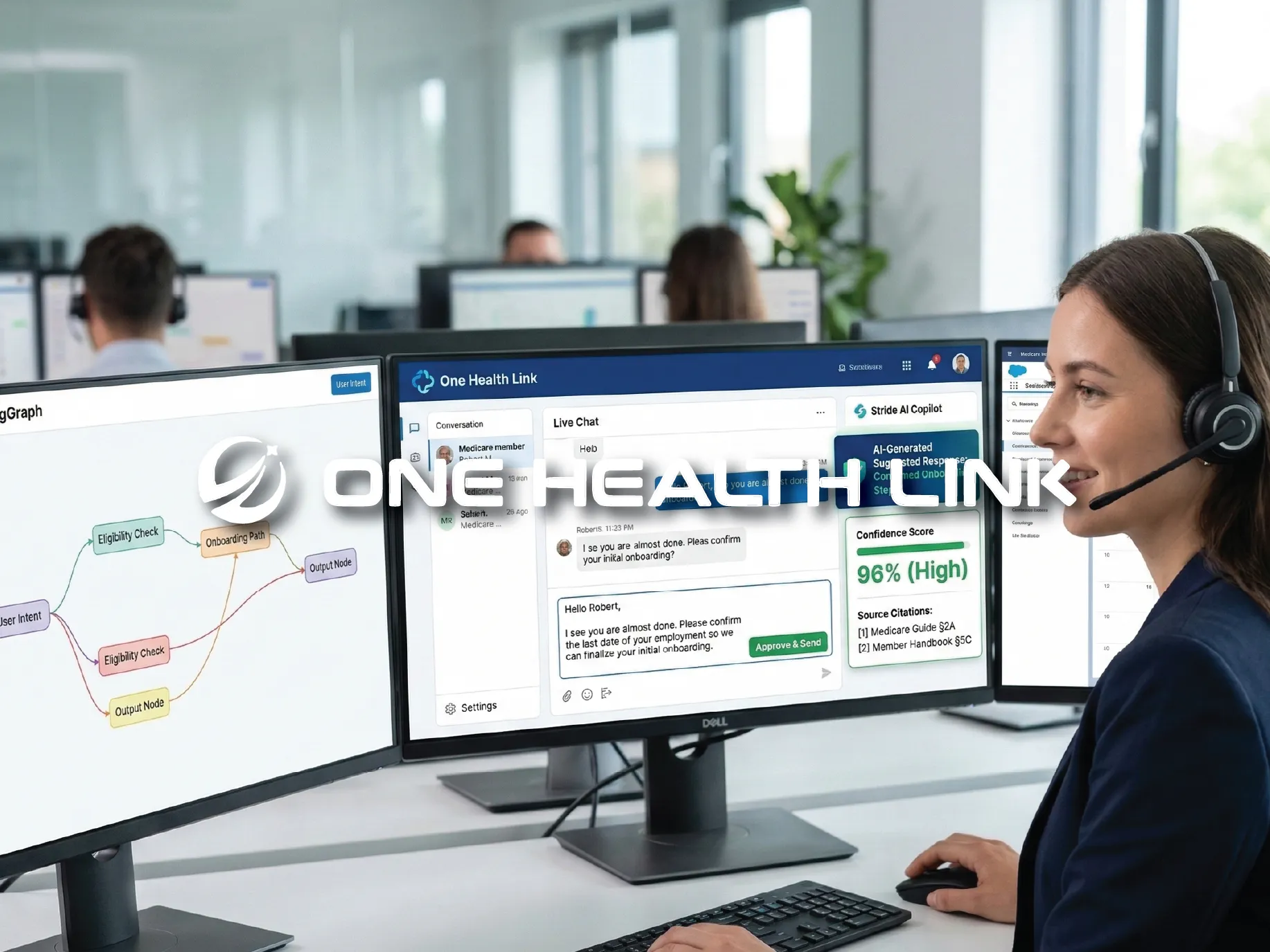
AI Adoption Cuts Live Chat Response Times From Minutes to Seconds
One Health Link partnered with Stride to build an AI-powered agent portal for their live chat call center. Intelligent response suggestions auto-populate in agent workflows while clinical oversight stays human-in-the-loop and HIPAA compliance is preserved end to end.

AI Adoption Compresses Financial Analysis From Hours to Minutes
A financial technology firm adopted AI-powered natural language querying to unlock institutional knowledge trapped in proprietary databases. Analysts now generate complex multi-period financial models in minutes, with no code required and full auditability preserved.

AI Adoption Uncovers Decades of Technical Debt and a Path Forward in Weeks
A Latin American automotive group adopted Stride's AI tooling to tackle a decades-old dealer management system. AI agents cut module analysis from days to hours, giving leadership a concrete adoption roadmap and a path to modernization without a costly full rewrite.
Frequently Asked Questions About Team AI Upskilling
What is team AI upskilling and why does my team need a partner?
Team AI upskilling moves an engineering team from individual AI tool usage to disciplined, AI-assisted delivery that ships reviewed software. Adoption is already done on most teams. The gap is value: more AI output without the discipline to turn it into shipped, accountable software just produces more rework and instability. Stride engineers embed in your team, run the full delivery cycle with you on your production code, and leave the discipline behind so your team runs it without us.
What does a Stride upskilling engagement actually deliver?
Shipped, reviewed software, a team that owns the method, and the metrics to prove quality is holding. Inside an engagement we run the whole product development lifecycle on your production code: discovery and product definition, thin vertical slices, build with PDCA, test and deliver, and retrospection at every level. Senior Stride AI engineers work as player-coaches alongside your engineers, a product owner, and a business analyst, and the discipline transfers as the code ships.
Is this just training, or vibe coding with extra steps?
Neither. It is disciplined development with agents. Using a set of proprietary Claude skills, the team applies the Plan-Do-Check-Act cycle to every change: an approved plan before any code, test-first implementation, a completeness check against the plan, and a retrospective. Two things set the approach apart from common agentic-coding playbooks. It is prescriptive about test-first development, where others leave it optional. And it closes every cycle with a retrospective, where others skip it entirely.
What is the J-Curve and why does it matter?
DORA calls it the J-Curve: an initial dip in productivity and stability before the returns arrive. Even high-performing teams struggle through the learning phase of any significant new technology. Leaders who misread the dip as failure pull funding before the curve turns. Teams that navigate it with discipline reach the other side and capture the projected 39% first-year ROI. Most pull funding first.
How do you measure that quality is holding?
A DORA metrics toolkit runs on every pull request and again each week. Every change is scored against explicit healthy targets: large commit rate under 20%, sprawling commit rate under 10%, test-first discipline over 50%, commit message quality over 60%, net additions ratio under 0.50, and average files per change under 5. Thresholds are configurable to your baseline. A number that drifts surfaces before the problems it predicts become real. That is the early warning adoption metrics alone do not give you.
What does my team own after 60 days?
On a typical engagement, by day 60: your engineers run the full delivery cycle on their own, without coaching prompts; working software has shipped and been reviewed with real users, with feedback documented; delivery velocity is stable or improved against your baseline; quality holds, with test-first discipline above 50% and large unreviewed commits under 20%; and your engineers can explain, demonstrate, and teach the method to a peer outside the team.
How is this different from a Copilot or tool rollout?
A tool rollout gives your engineers access and a dashboard that shows adoption. It does not change how work moves from a user need to shipped software, and it does not measure whether quality is holding under AI tooling. Stride runs and teaches the whole product development lifecycle on your production code, enforces test-first discipline and retrospection, and scores every pull request against healthy targets. Adoption is easy to see. Value is what the discipline produces.
Where do we start?
The first step is a 90-minute workshop for your engineering leaders. They watch the full PDCA workflow run live on a real codebase and locate where their teams stand today using the DORA team profiles. From there, we form the co-sourced team, pick a real piece of work on your production codebase, and run the full cycle in the open, every day. We ship working software together.
Insights from Stride
Strategy First: Why the Crawl Phase Determines Everything
Getting AI adoption right starts before the first tool is deployed. Francisco Martin on why the crawl phase determines everything that comes after it.
Read More →How AI Is Transforming the Software Services Industry
The structural shift reshaping how software services firms compete as AI moves from add-on to core delivery. What changes for the firms that build, and the buyers who choose them.
Read More →How We Built a Clinical AI Agent
A production walkthrough of the AI agent Stride built for a healthcare client, supporting patients in a sensitive clinical use case using LangGraph, Claude Sonnet, human-in-the-loop safeguards, and a custom evaluation framework.
Read More →Let's Turn AI Speed Into Shipped Software.
Your engineers are already fast with AI. The open question is whether that speed becomes shipped, reviewed software that moves the roadmap, or more raw output that creates rework downstream. Stride's team AI upskilling practice exists to help engineering leaders close that gap: a co-sourced team that builds with you on your production code, runs the Plan-Do-Check-Act cycle on every change, measures quality on every pull request, and leaves your team able to run it all without us. Whether you are watching the J-Curve dip and wondering if it will turn, or you simply want AI speed you can stand behind, the conversation starts the same way: a 90-minute workshop on a real codebase.