

Fleet Management Company
Stride built custom AI tooling and a domain knowledge foundation for a Latin American automotive group, cutting module analysis from days to hours and creating a clear path to modernize a decades-old dealer management system.
Company Background
The client is a well-established automotive group in Latin America with roughly 1,000 employees and more than six decades in business. The company distributes vehicles through a network of dealerships across the region and handles vehicle distribution, fleet operations, dealership management, and after-sales service.
At the center of day-to-day operations is a proprietary Dealer Management System (DMS) built in Visual Basic. The company built and maintained it internally over decades. The system works well for what it does, and there was serious interest in eventually licensing it to other dealership networks across the region. To do that, they first needed to modernize it.
Challenge
The DMS had grown organically for decades without formal documentation. Understanding what any given part of the system did was a significant undertaking on its own. The codebase was tightly coupled, written entirely in Visual Basic, and had no clear architectural boundary between components. A conventional rewrite would take more than two years, which wasn't viable for the business.
The path forward required moving to a modern microservices architecture, with event-driven patterns and a proper separation of concerns. But before any of that work could happen, the team needed to understand what they were actually working with. The client needed help cutting through the complexity, building out the knowledge foundation, and creating tooling that would make AI-assisted code generation practical.
Solution
Stride's first engagement focused on the foundational work: building the knowledge base and tooling that would make code generation useful rather than just fast. Jumping straight to generating code before the system was properly understood would have created more problems than it solved.
Stride ran workshops with the client's business and technology teams to map the domain, model the data, and document the core use cases the DMS supported. This brought together management, expert users, and architects to capture institutional knowledge that had never been written down. The output was a set of structured artifacts that the modernization effort could actually build on.
Alongside that, Stride built custom AI tooling for the codebase: a tracing tool to follow code paths through the legacy system, a story augmentation capability to enrich backlog tickets with relevant codebase context, and early code generation workflows that produced suggested changes ready for architect review. Each tool was built to give the client's architects more leverage per hour spent.
Stride also worked with technology leadership to define the target architecture and sequence an initial release scope that could demonstrate value without betting everything on a single large migration.
Outcomes
- A Codebase That AI Tools Can Actually Reason About: The DMS went from an undocumented legacy system to one with domain models, data structures, and tracing infrastructure in place. That's what made code generation viable rather than speculative.
- Module Analysis Time Cut From Days to Hours: The tracing and visualization tooling gave architects a way to understand each piece of the system without spending days on manual analysis. The team could move faster without losing confidence in what they were changing.
- A Clear Architecture and Migration Plan: Target state architecture defined. Initial release scope sequenced. Leadership had a concrete, risk-managed roadmap for replacing the DMS piece by piece without disrupting dealership operations.
- Foundation for a Licensable Product: With proper domain modeling and architecture patterns in place, the client is now on a path to build the modernized DMS as a product that can serve other dealership networks across the region, not just their own operations.
Success Stories
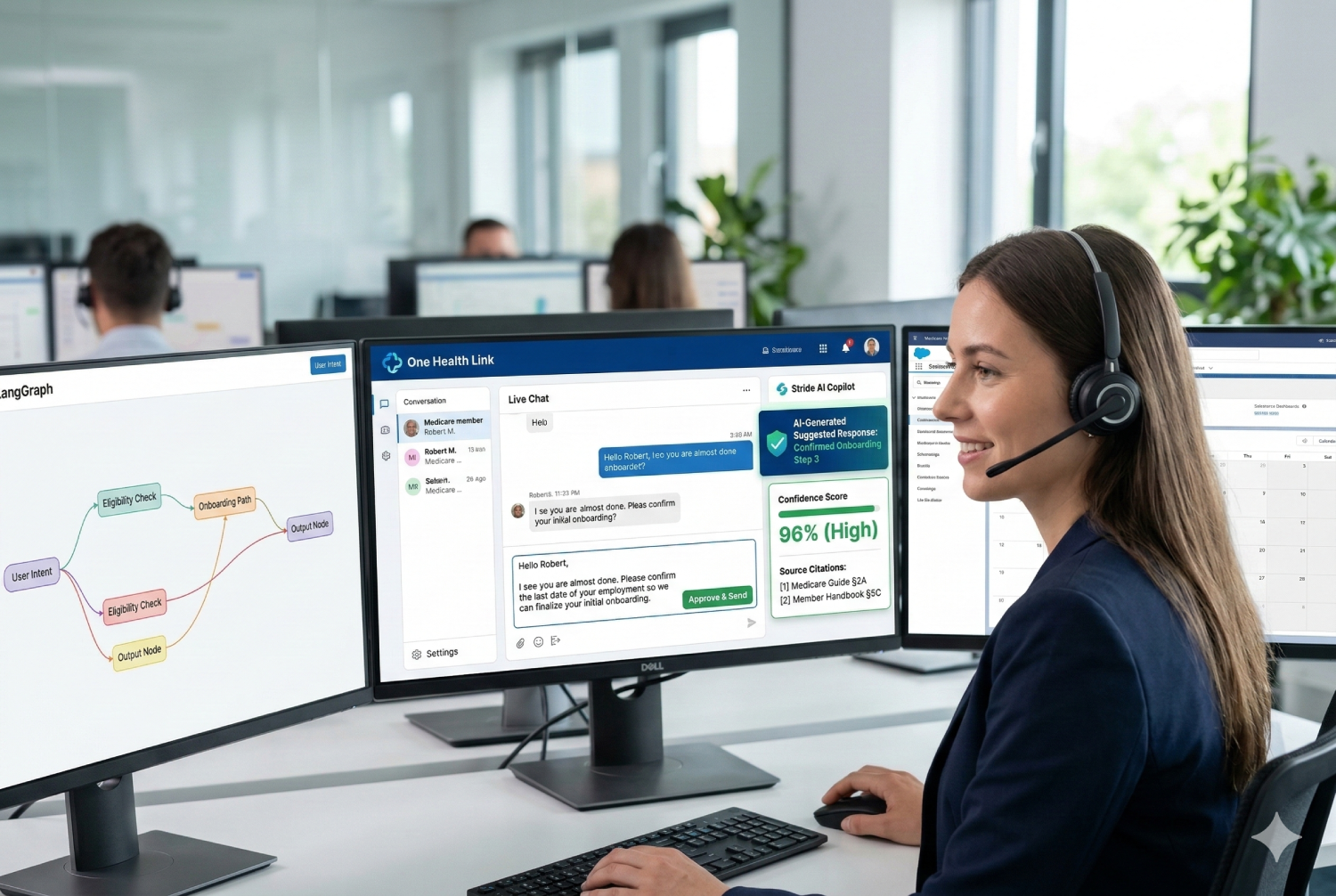
HEALTHCARE AGENTS REDUCE WAIT TIME 95%

FINTECH: AGENTS REDUCE HOURS TO MINUTES

HEALTHCARE: SMS AGENTS SAVE $360K ANNUALLY

AVIATION: LEGACY APP MODERNIZATION REDUCES VULNERABILITIES 99.8%
