

Association Management
Stride built AI-powered migration workflows for a legacy membership platform, cutting module analysis from 3 days to 3 hours and compressing a 2-year rearchitecture project to under 12 months.
Company Background
The client provides financial operations software for multi-chapter membership organizations, including trade associations, professional groups, and fraternal organizations. The platform handles dues billing, fund transfers between chapters and national organizations, membership management, events, certifications, and CRM. It has grown through a series of acquisitions into a multi-product suite serving a wide range of chapter-based groups.
The core of the platform is an application built more than a decade ago. It handles high-volume financial flows and is critical to daily operations. That history shows: 600-plus classes, 10,000 individual code files, and 2,000 database tables, all accumulated over years without a clear exit ramp.
Challenge
The codebase had started causing real customer problems. Long call chains in the legacy system were timing out during sign-up and payment workflows, directly hitting revenue. The engineering team spent most of its time applying caching fixes and patches just to keep things running. There was almost no bandwidth left for building anything new.
The team had a solid strategy: gradually move business logic out of the monolith and into a modern service layer, keeping the existing frontend and database in place for now. The problem was execution speed. Understanding a single class well enough to migrate it safely took three days of manual work. At that rate, the full rearchitecture would take over two years, which wasn’t acceptable.
Solution
Stride built a set of AI workflows and automation tools designed around the client’s existing migration strategy. The approach kept architects in control of every important decision while dramatically reducing the time spent on lower-leverage parts of the work.
The first tool was a dependency tracer and visualizer. It traversed the codebase, mapped database schemas and stored procedures, and produced detailed diagrams of how components related to each other. Analysis that previously took three days per module dropped to just over three hours. Architects could finally see the system clearly without having to reverse-engineer it by hand.
The second piece was an implementation recommendation workflow. It fed the traces and visualizations into a GenAI workflow that generated a migration strategy for each service unit. Architects reviewed and refined each recommendation before anything was acted on. The human judgment stayed in the loop at the point where it mattered most.
The third piece was code generation. Automated workflows used the diagrams and approved strategies to build detailed prompts for an LLM, which produced suggested code changes submitted directly as pull requests. Engineers reviewed and accepted the output using the same process they already used for any other code change.
Outcomes
- 2-Year Project Compressed to Under 12 Months: The AI-powered workflows more than doubled the pace of service migration, saving over a year of engineering time on a project that had no good path forward at its original speed.
- Module Analysis: 3 Days to 3 Hours: Dependency-tracing visualizations changed how architects spent their time. Instead of manual codebase archaeology, they could focus on the decisions that actually required their judgment.
- Pull Request-Ready Code at Scale: Code generation output landed directly in the team’s existing review workflow. No new process required. Engineers reviewed AI-suggested migrations the same way they reviewed any other code.
- Expanded Across the Codebase: After the initial delivery, the client scaled the tooling across the broader codebase. The approach held up as the scope grew.
Success Stories
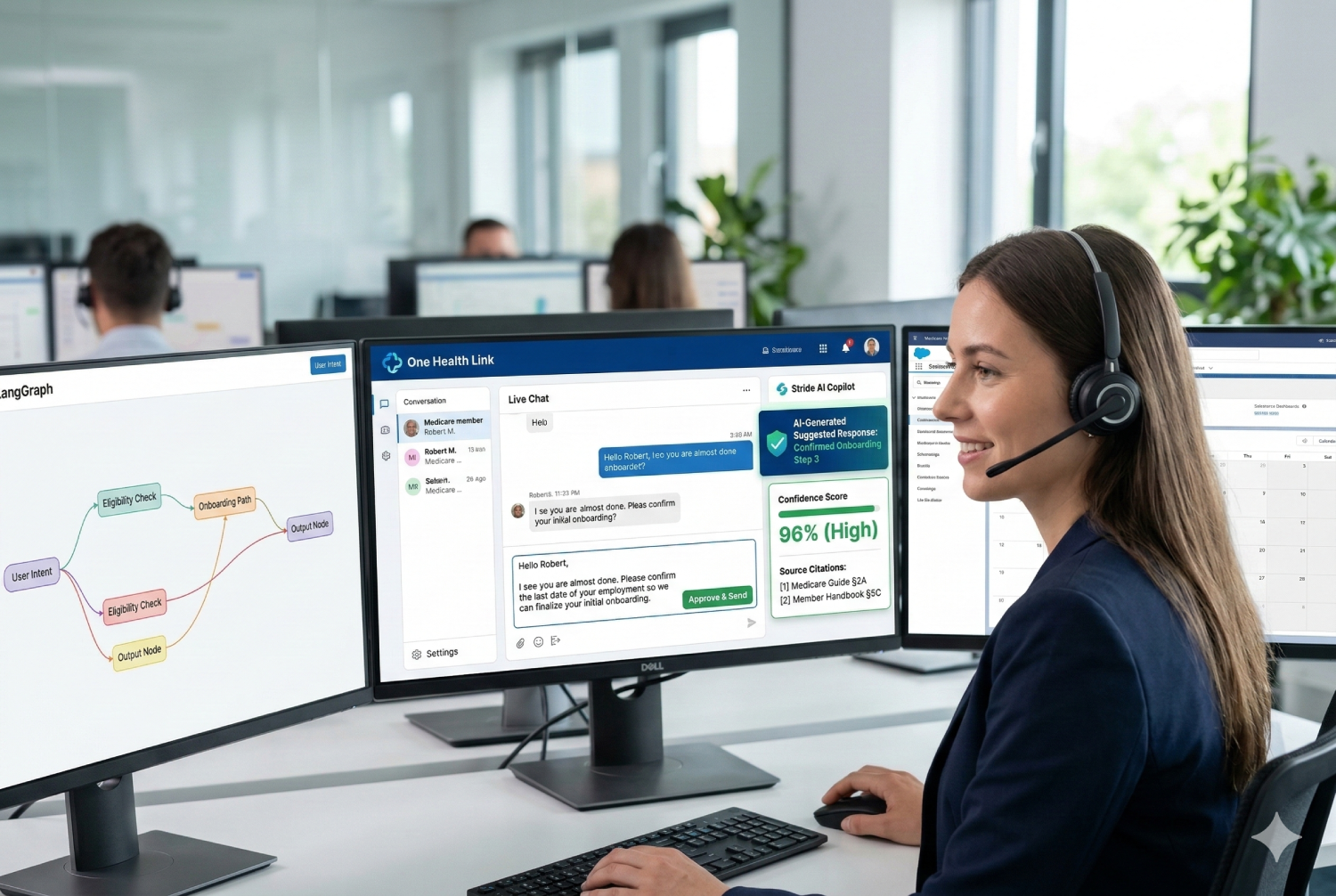
HEALTHCARE AGENTS REDUCE WAIT TIME 95%

FINTECH: AGENTS REDUCE HOURS TO MINUTES

HEALTHCARE: SMS AGENTS SAVE $360K ANNUALLY

AVIATION: LEGACY APP MODERNIZATION REDUCES VULNERABILITIES 99.8%
