Individual AI Experimentation Doesn't Scale. Shared Rituals Do
This is the fourth post in our five-part series on scaling AI-assisted engineering. So far the moves have been technical: structure the repos, build the knowledge layer, run bounded sessions with real planning discipline. This one is organizational, and it's the one that decides whether any of the earlier work compounds or stays stuck at the level of individual talent.
Individual experimentation makes individuals better. That's the problem
Right now your strongest engineers are getting genuinely good with AI tooling. Each of them has worked out their own way of running sessions, their own prompts, their own habits. That's real skill, and it's exactly why your delivery numbers still haven't moved the way leadership expected.
When every engineer runs AI their own way, every improvement stays local. One person gets faster. The person next to them learns none of it. The organization does not learn, because there is no mechanism for what one engineer discovered to become how the team works. You've raised the ceiling for a few people and left the floor where it was.
This is the chatbot plateau in a different form. Individual productivity tools lift individuals. Organizational throughput moves only when the practice is shared. A policy mandate doesn't create shared practice. A shared ritual does.
Two rituals that move practice from person to team
The framework behind this series addresses the problem with two collaborative rituals, and the word collaborative is load-bearing.
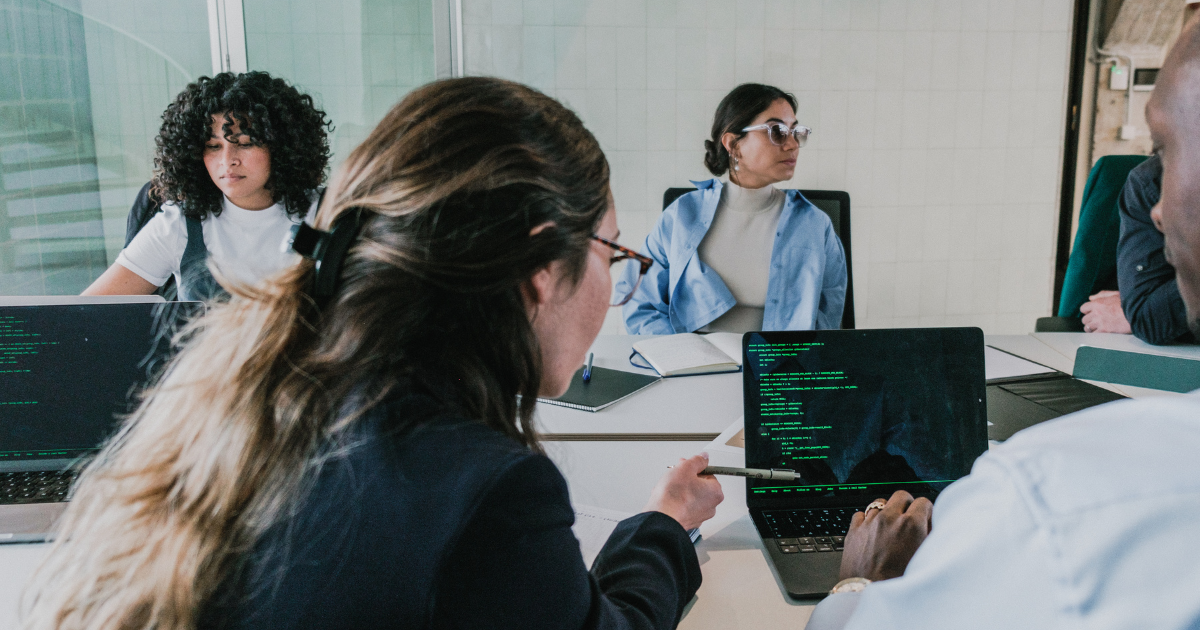
The first is mob elaboration. The product owner, developers, QA, and the relevant stakeholders review and refine the AI-generated artifacts together, in the same room or the same call, before the work is built. The claim, and it matches what we see, is that this condenses weeks of sequential back-and-forth alignment into hours, and the alignment sticks because everyone built it together rather than receiving it secondhand.
The second is mob construction. Teams work together through delivery, exchanging the integration details as they go and shipping the bounded units of work from the last post as a group, with AI playing a central role at each step. The point of both rituals is the same: the good practice that used to live in one engineer's session becomes something the whole team sees, questions, and absorbs.
Rituals come before pipeline agents, not after
There's a strong temptation to jump straight to centralized pipeline agents: automated code review, security scanning, test coverage. Those are the right next layer, and they follow the same design principle as everything else in this series. Each agent gets a defined scope and a structured output schema. It reasons within its domain, the orchestration around it governs what it can contribute, and one agent's bad output doesn't contaminate the pipeline.
But sequence matters. Build those agents before the rituals exist and you get agents that no one feeds good context, producing output no one has the shared discipline to evaluate. The ritual is what makes the automation worth having. Reverse the order and you've automated a process your team hasn't agreed on yet.
The honest prerequisite: rituals need safety
Here's where I'll be direct, because pretending otherwise wastes your time. Mob rituals require genuine collocation or excellent remote collaboration infrastructure. They also require psychological safety, specifically the safety to challenge an AI output in front of colleagues and say "I don't trust this, here's why." Teams that don't have that will go through the motions of the ritual and get none of the benefit.
For some organizations, that means the change program is the prerequisite, not the follow-on. If your teams can't yet challenge each other's work openly, that's the first thing to build, before the rituals can do anything for you. Naming that up front is cheaper than discovering it three months in.
Start with one team, not a mandate
The move from individual experimentation to shared practice is not something you announce. Pick one product group with a strong product owner and a team willing to invest, run the rituals there, and let the results make the case. When that group's delivery improves in a way the rest of the organization can see, you have something a mandate could never buy: proof, and a team that can teach the next one.
We saw this dynamic concretely on a healthcare engagement built around shared practice and intelligent model routing, where routine requests were sent to cheaper, faster models and only the hard ones reached the expensive tier. It produced hundreds of thousands of dollars a year in measurable savings, and the insight underneath it was that cost and performance weren't in tension at all. The cheaper models were often faster for routine work. That kind of finding is worthless if it stays in one engineer's head. Inside a shared ritual, it becomes how the whole team operates.
If your best engineers are getting better while your organization stays flat, the gap isn't talent. It's that the practice isn't shared, and no memo will fix that. Installing shared rituals on your real delivery process is what a Team AI Upskilling engagement is built to do. Let's talk.
Frequently asked questions
Why doesn't individual AI experimentation scale? Because improvements stay with the individual. When each engineer uses AI their own way, one person gets faster and the team learns nothing from it. Organizational throughput only moves when the practice is shared, which requires a mechanism for one engineer's discovery to become how the team works.
What are mob elaboration and mob construction? They're two collaborative rituals. In mob elaboration, product, engineering, QA, and stakeholders refine AI-generated artifacts together before building, which compresses sequential alignment into hours. In mob construction, the team delivers bounded units of work together with AI central at each step, so good practice spreads across the team.
Should we build automated pipeline agents first? No. Centralized agents for code review, security scanning, and test coverage are the right next layer, but only after shared rituals exist. Built first, they produce output no one has the shared discipline to evaluate and that no one feeds good context. The ritual is what makes the automation worth having.
Can we roll shared rituals out with a policy mandate? A mandate doesn't create shared practice. Rituals need genuine collaboration and the psychological safety to challenge AI outputs openly. Start with one product group willing to invest, prove the results, and let that team teach the next one.
This is Post 4 of Stride's five-part series, AI-Assisted Engineering at Scale. Next: why you should measure fluency, not maturity.